
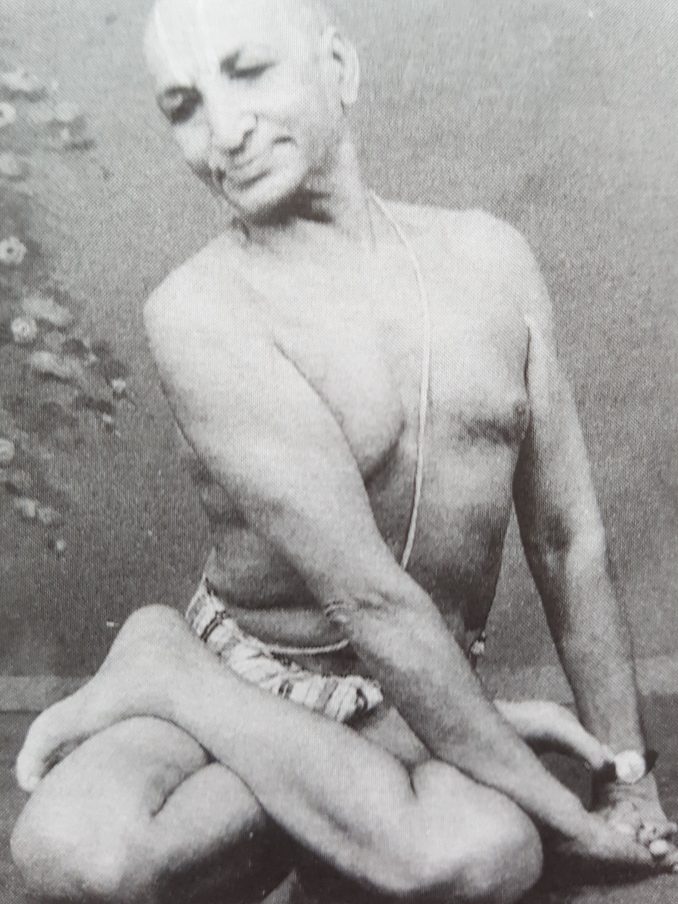
Achieving Inner Peace – Teachings from Sri T. Krishnamacharya
How can we cultivate a peace that remains with us even when life becomes challenging?
In his Yoga Makaranda, also known as Yoga Saram or The Essence of Yoga, Sri T. Krishnamacharya offers two beautiful perspectives: Dayā, our attitude towards others, and Santoṣa, our relationship with the changing circumstances of life.
Dayā – An Open Heart Towards Others
Dayā is often translated as compassion, kindness or open-heartedness.
In the Yoga Makaranda, Krishnamacharya includes Dayā among the Yamas – ethical guidelines for the way we relate to other beings and to the world around us.
He describes an attitude of goodwill that does not depend on whether someone is a friend, a stranger, a relative or even an enemy.
Paraphrased from Sri T. Krishnamacharya, Yoga Makaranda, section on Yama and Niyama.
This is a demanding practice. It asks us to look beyond our immediate preferences, judgments and reactions.
Dayā does not mean that we must agree with everyone, tolerate harmful behaviour or abandon our boundaries.
Rather, it invites us to cultivate goodwill without losing clarity. We can protect ourselves, say no and still choose not to respond with cruelty.
Santoṣa – Contentment Within Change
Santoṣa means contentment – a quality of inner acceptance that is not entirely dependent on external circumstances.
It belongs to the Niyamas, the personal observances that support our inner life and our practice.
Krishnamacharya describes Santoṣa as the capacity to meet both pleasure and sorrow with a peaceful, contented mind, even as time, place and circumstances change.
Paraphrased from Sri T. Krishnamacharya, Yoga Makaranda, section on Yama and Niyama.
Contentment is not the same as resignation.
We can recognise suffering, work towards change and still cultivate a measure of inner steadiness.
Santoṣa reminds us that peace does not have to wait until everything in life is exactly as we wish.
I explore this quality more deeply in my article Santosha – Freude ohne Schatten (in German).
Yama and Niyama – Two Dimensions of Practice
Yoga is not only a practice of postures, breathing and concentration. It also invites us to examine how we live.
The Yamas offer guidance for our conduct towards others. The Niyamas concern the attitudes and observances through which we cultivate our inner life.
In the Yoga Makaranda, Krishnamacharya presents ten Yamas and ten Niyamas. This is a broader enumeration than the five Yamas and five Niyamas found in Patañjali’s Yoga-Sūtra.
Dayā and Santoṣa are therefore not simply two pleasant qualities. They belong to a larger ethical and contemplative understanding of yoga.
Together they point towards a peace that is both relational and inward.
Bringing These Teachings Into Daily Life
We do not need extraordinary circumstances to practise Dayā and Santoṣa.
They can become part of ordinary moments: a difficult conversation, an unexpected change, a disappointment, or a quiet morning on the yoga mat.
When someone challenges us, Dayā invites us to pause before responding.
When life unfolds differently from our expectations, Santoṣa invites us to notice what remains possible in the present moment.
Neither quality requires perfection. Both can be cultivated gradually, through awareness and repeated practice.
Questions for Reflection
- Can I remain open-hearted towards someone with whom I disagree?
- Where do I confuse kindness with the need to please others?
- What happens when circumstances do not meet my expectations?
- Can I experience contentment without giving up my wish for change?
- What would Dayā and Santoṣa look like in my life today?
Read the Yoga Makaranda
If you would like to explore these teachings in their original context, I warmly recommend reading Sri T. Krishnamacharya’s Yoga Makaranda.
First published in Kannada in 1934, the work was later translated into Tamil. An English translation by Lakshmi and Nandini Ranganathan, based on the Tamil edition, was made available for free distribution.
The book offers a fascinating insight into Krishnamacharya’s approach to yoga and includes historical photographs of his Āsana practice.
The first link leads to a resource page about the freely distributed translation. The second preserves the original download link shared in this article.
Bringing the Teachings Into Practice
Yoga philosophy becomes meaningful when it begins to shape our practice, our relationships and our everyday lives.
In my yoga teacher training in Innsbruck and my online meditation and Yoga-Sūtra offerings, we explore these teachings with attention to both their traditional sources and our own experience.
Schreibe einen Kommentar